Hard To Be God

Updated: May 10

The Strugatsky brothers wrote their mind boggling novel - Hard to be God - in 1964, about a historian from the future sent to observe a medieval planet. He arrives with superior knowledge, rational instincts, and the quiet confidence of a man who believes competence is transferable across civilisations. He is wrong, spectacularly and repeatedly, in ways that take him the entire book to understand. I read Hard to Be God many years before going to Kashmir. I guess I forgot the lessons of that novel.
I went to Kashmir with the kind of confidence that usually precedes either a breakthrough or an avoidable disaster. The confidence came from a familiar source - previous bad decisions that had worked out well. I had left the most prestigious engineering institution of my country to pursue my artistic dreams. I had gone to Russia to built a career in audio engineering despite repeated warnings and had one of the best experiences of my life. That is the danger of successful recklessness - it convinces you that intuition is wisdom and luck is a transferable skill.
Before Kashmir, my life was a study in productive disorder. I had made money - more than I had expected, faster than I had planned. But money, it turns out, is easier to accumulate than a life. My personal world was quietly coming apart at the seams. Nothing dramatic. No single rupture. Just the slow, ambient chaos of a person who had optimised for creative outputs and forgotten to build everything else. I had no shape to my days, no anchor, no peace in stillness. I was busy in the way people are busy when they are running from something they cannot name. I wanted to retire. I wanted to stop. I had a very specific dream: a recording studio with a glacial view of the Himalayas, where I could make music, a photography studio where I could sketch my muses and think long thoughts, and finally, finally, slow down. I did not know how to begin. Kashmir seemed like the answer to a question I had not yet properly formed.
So when life in Goa began to feel too slow, too repetitive, too comfortable - and other almost malevolent forces had thrown a wrench in my life plans - Kashmir appeared on the horizon like a fresh temptation. My father had been posted there as a civil engineer. He had spent two years in Kashmir and like many sensible men and women who spend enough time around mountains, my parents had become temporarily irrational. They had fallen in love with the region and decided to create a second life there: a home, perhaps a hotel, perhaps a future large enough to justify the decision later. I joined them because boredom is one of the most persuasive forces on earth. I also fancied the idea of retiring early after making money elsewhere. This is something many men say before discovering that idleness is intolerable and retirement without inner peace is just unemployment with better stories. Kashmir sounded perfect.
Beauty. Adventure. Real estate. Tourism. Reinvention. A studio with a mountain view. What could possibly go wrong? The answer, as it turned out, was: almost everything, but in fascinating ways.

I arrived in March 2024 and stayed until March 2025. The first two months were glorious enough to make future suffering and anticipations feel worth it. Before I speak of anything difficult, I should say plainly what is true. Kashmir is stunning beyond the vocabulary available to ordinary travel writing. Kashmir can feel unreasonable. Paradise on earth is an overused phrase. Kashmir sometimes makes it sound conservative.
Positioned at the entrance to this paradise, standing at every major viewpoint, every tourist hotspot, every famous garden and famous lake and famous meadow - men with guns. The armed forces are a constant presence in Kashmir's tourist landscape - not hidden, not apologetic, simply there, as unremarkable to locals as lampposts and considerably more numerous. You adjust to this faster than you expect to, which is itself unsettling. Within a few weeks I had stopped consciously registering the rifles. They became part of the scenery, like the mountains behind them, which is precisely the kind of normalisation that should keep a person awake at night.
The tourists, however, had not adjusted. And they found an innovative use for the armed personnel stationed at scenic spots across the valley: complaints management. I watched, on multiple occasions, a tourist who had been charged 10000 rupees for an hour long horse ride or 100 Rs for a water bottle march up to the nearest soldier and demand justice. The soldier, assault rifle slung across his chest, would listen with admirable patience while someone from Rajasthan or Delhi or Gujarat explained at length that the correct price for a horse ride was definitely not 10000 bucks. The soldier could not fix the price of horse rides. He was there for other reasons entirely. But he was the only authority figure visible, so he received the complaint. It was, in its way, a perfect metaphor for Kashmir's tourist economy: militarised infrastructure deployed to manage a conflict, now doubling as a consumer grievance helpline. The guns did not make the horse ride prices lower. Nothing made the horse ride prices lower.

I had a houseboat. And for the first stretch - before the season arrived and chaos became my employer - I had it largely to myself. Those off-season months on Dal Lake were among the most quietly beautiful periods of my life. The lake in the absence of tourists is an entirely different creature. No shikara hawkers, no honeymooners quarrelling through thin walls, no suitcases dragged like corpses across the deck at midnight. Just water, mist, the occasional bird, and a silence so complete it had texture. My companions in those months were my houseboat crew - a handful of young men who, freed from the performance of tourist season, became simply themselves - and the cats of Dal Lake. There are many cats on Dal Lake, and they are unlike cats elsewhere in one specific respect - they are not afraid of water. They sit on the edges of boats with the confidence of sailors. They wade through shallows without complaint. They watch the lake with the proprietary calm of creatures who consider it theirs and merely allow the houseboats to float on it as a courtesy. In those slow months I learned to row a boat properly, which is harder than it looks and more meditative than anything I had paid for in that category. I fished in the afternoons, often catching nothing, occasionally catching a bountiful, always catching the particular quality of silence that exists on a lake before the rest of the world has woken up and decided to be loud. The cats supervised from nearby, professionally interested in the fishing and professionally indifferent to everything else. I drank tea, smoked weed, read books, sketched, played guitar and watched the mountains do nothing and felt, for the first time in years, that I was not behind on anything. The dream I had carried from Goa - a studio, a glacial view, stillness earned rather than collapsed into - felt briefly achievable. The lake in winter delivered a version of it for free. Then the season arrived. And with it, everything else.

Living on a houseboat through peak tourist season sounds romantic until you do it long enough to understand that romance is often just discomfort with good lighting. There is no privacy. None. You hear every footstep, every request, every child sprinting indoors, every uncle coughing theatrically, every late-night honeymoon quarrel, every door slam, every kettle whistle, every suitcase dragged like a corpse across wood. Water carries sound with special enthusiasm. Even silence arrives damp. Peak tourist season turns charm into captivity. You are surrounded by people having holidays while you are at work. This is psychologically corrosive. It is like being locked inside someone else's Instagram feed. And the Instagram feed observation, I found, was more literal than metaphorical.
Kashmir in tourist season is a place of extraordinary beauty being systematically ignored in favour of its documentation. I watched people arrive at viewpoints that would stop your breath if you gave them half a chance - the mountains, the valleys, the light doing things with clouds that no algorithm could replicate - and spend their entire time there making reels. Not looking. Filming themselves not looking. A thirty-second video of a place they had not actually seen, to be watched later by people who also would not see it. I am not romantic enough to condemn this entirely. But I spent long hours simply staring at mountains, at rivers, at the way afternoon light moved across a meadow, and I can report that it is a different activity from photographing them. It produces different things inside a person. Kashmir rewards the long look. Most visitors never gave it one.

Tourism season also delivered another peculiar ritual, conducted every evening with remarkable consistency outside the newly opened wine shops of Srinagar. Kashmir had recently permitted alcohol sales, and the shops were doing brisk business - almost entirely with tourists, who queued in volumes that suggested they had been rationing themselves since the drive up from Jammu. What made these queues sociologically interesting was the negotiations happening at their edges. Locals - unable to be seen purchasing alcohol by neighbours, relatives, colleagues, or anyone within a several-kilometre radius who might mention it to anyone else - would approach tourists with quiet, urgent requests. Bhai, ek bottle leke dena. Brother, pick one up for me too. The tourist would emerge with two bottles instead of one, hand one off discreetly, and everyone would proceed with their evenings. It was a small, harmless conspiracy repeated dozens of times every night across the city. A workaround so efficient it had become infrastructure. The prohibition was not on alcohol exactly - the shops were legal and open. The prohibition was on being seen wanting it. In Kashmir, appearances and reality have always operated on separate budgets.

Eventually I developed a survival habit to escape the deluge of tourists: disappearing. I would walk for hours along the banks of Dal Lake, escaping guests, staff, invoices, and the smiling tyranny of customer service. Those walks saved me more than I understood at the time. Somewhere along them, the beautiful & peaceful Barista opposite Ghat no. 21 became my embassy. The staff there began recognising me from absurd distances. By the time I approached, my caesar salad, iced coffee, and an ashtray would already be arranged at my preferred table. Outdoors if the weather was decent. Indoors if rain had made other plans. That level of service can create dangerous emotional attachment. I held meetings there, sketched ideas there, wrote notes there, finished several books, stared into middle distance there, and occasionally performed the modern male ritual of looking productive while internally collapsing. They let me stay beyond closing time. They allowed me to roll & smoke in peace in the adjacent private garden. I owe them gratitude. In a region full of chaos, they offered something radical: predictability and serenity.
But the Kashmir that saved me - the one I carry most carefully in memory - was not the Kashmir on any tourist map. It was the Kashmir that opened only through trust, and trust took time to earn. A local village sarpanch from Anantnag, a man of few words and impeccable instincts about people, began taking me places that have no names in any guidebook. Not because they are secret, exactly, but because they exist outside the economy of tourism entirely. Hidden ancient cave temples in the forests of Anantnag, half-swallowed by roots and silence, their carvings worn soft by centuries of mountain air. Frozen lakes tucked between two mountain tops. Barbeque and camping in the beautiful forests behind the villages while taking shelter in old Gujjar Huts. You do not stumble upon them. You are taken there, when someone has decided you are worth the trouble. Off road drives with my adventurous freinds in Kashmir. Their stunning farmhouses, poultry farms and secret spots aroused unprecedented envy in me.

I stayed in village homes in Anantnag, Gulmarg, and Doda district - sleeping on thin mattresses, eating food cooked on wood fires, waking to the sound of livestock before dawn. The hospitality was absolute and completely without performance. These families had almost nothing by urban measures and offered everything without hesitation. What struck me most in these villages was something I had not expected to miss: the evening. In urban India, the evening is a private affair - you retreat to your flat, your screen, your curated isolation. In the villages of Kashmir, the evening is communal and unhurried. People gather. Elders, neighbours, whoever happens to be passing. They sit together, light up their cigarettes & bidis and talk about everything - their families, their problems, a dispute in the next village, something funny that happened at the market, something worrying that happened at the border. Not performing conversation for an audience but simply being present with each other in the way that used to be unremarkable and has become, in cities, a kind of luxury. There was a warmth to these evenings that had nothing to do with hospitality in the formal sense. It was just people, refusing to be alone with their thoughts when company was available. I sat in on many of these gatherings without understanding most of what was said, and came away feeling something I could not immediately name. Later I identified it - I had been in the presence of community. Actual community, not the word we use in pitch decks and neighbourhood WhatsApp groups.

And then I would look at the young people of the same villages, and the whiplash was considerable. Kashmir's youth - not just in cities, but in villages, in remote valleys, in places where the internet connection should by rights have been impossible - were among the most phone absorbed people I have encountered anywhere. More so, I thought, than urban Indian youth, which is saying something. The same mountains I could not stop looking at held zero competition for a screen. The same rivers, the same skies, the same light that I had travelled hundreds of kilometres to witness - background noise. I found this strange, then instructive, then stopped judging it entirely. They had not chosen to be born into a landscape. They had been issued it, the way you are issued a home town. You do not marvel at the walls and ceilings in your childhood bedroom. The beauty of Kashmir is, to those who grew up inside it, simply the weather. It is people like me - escapees from flat cities and cluttered lives - who turn mountains into philosophy & poetry. For them, the phone was the window to a world they actually wanted. The same irony I had found in the villages - they wanted what I had left, and I wanted what they were leaving.

Soon I noticed, in ways both subtle and occasionally absurd, that many Kashmiris seemed to trust outsiders like me more readily than their own people. At first I mistook this for hospitality. Later I suspected it was something darker: the reflexes of a low-trust society shaped by decades of conflict, corruption, surveillance, and disappointment. When institutions fail long enough, neutrality itself becomes a scarce resource. One afternoon, while attending a village function, I was invited with complete seriousness to help settle a local land dispute between two families. I had no qualifications beyond appearing educated and unaffiliated and knowing how to calculate surface areas, but that was apparently enough. For several hours I became a land surveyor by popular demand, pacing boundaries and listening to rival claims while the actual local surveyor watched with visible irritation. It was comic, flattering, and quietly revealing. In places where trust has thinned, a stranger can sometimes inherit more of it than a neighbour!

Gurez Valley & further on - Tulail Valley was the furthest I went, in every sense. It lies on the India-Pakistan border, a place so remote it had only recently opened to tourists at all. The people there are Shin - a distinct culture, a distinct history, a distinct face that carries traces of older migrations. They felt entirely unlike the rest of Kashmir, as if the mountains had preserved something the plains had long since dissolved. Standing there, I understood something about the novel I had brought as a warning - even paradise has its own internal worlds, invisible to the god passing through.
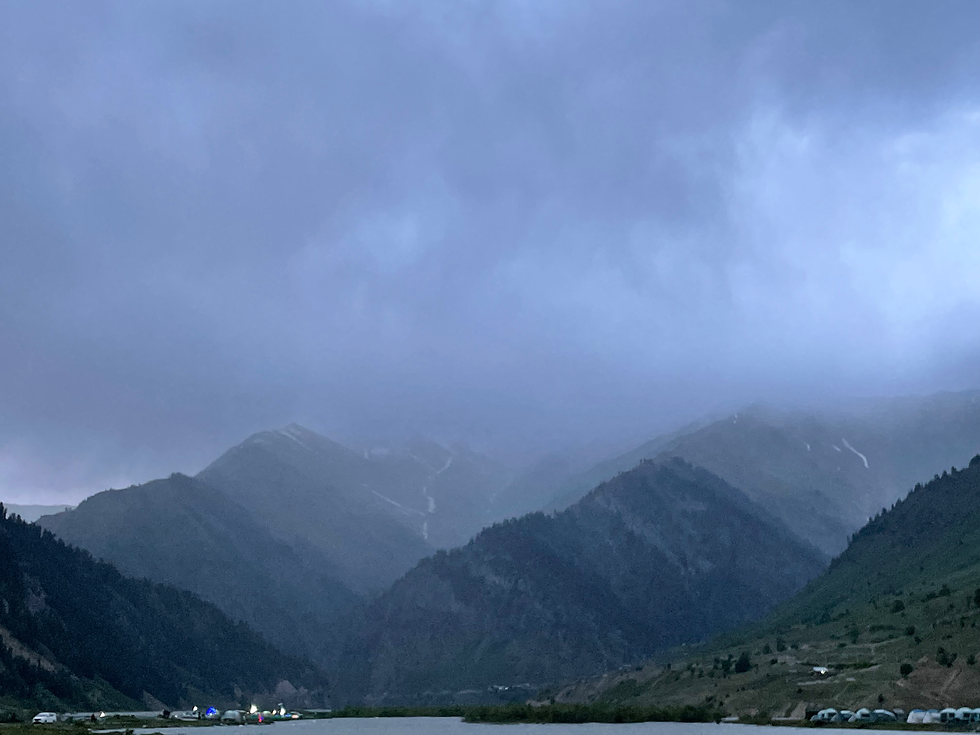
Then there was Toshmaidan - high meadows - the highest, the largest & widest & greenest carpet I had ever seen, clean air, complete silence replaced suddenly by bass and generators and Kashmiri elites in camping chairs watching the stars go by. Off-roading through mud in the afternoon, raves under mountain skies at night. It was absurd and joyful and very specifically a product of money. The same mountains, entirely different Kashmir. And if the working classes managed their exhaustion with Crocin and cough syrup, the elites managed their restlessness with considerably more sophisticated pharmacology: weed that arrived without fuss, rum poured without apology, and occasionally LSD consumed with the calm confidence of people for whom access to forbidden things had never really been the problem. The conservative surface of Kashmiri society, I learned, has a remarkably well-stocked underside. The rules apply with full force to those who cannot afford exceptions.

I should say something about the food, because to not do so would be dishonest and also a waste of your time reading this far. Kashmiris eat with a seriousness that puts most of the country to shame. Not occasionally, not on special occasions - constantly, royally, as a matter of non-negotiable daily principle. Wazwan, the great ceremonial feast, is the headline act that everyone mentions - course after course of lamb and mutton prepared in ways that suggest the cook has a personal relationship with the animal going back generations. But the headlines miss the daily texture. The bakeries open at dawn offering fresh bread and biscuits that make you question every other bread you have previously considered acceptable. The noon chai - a pink salted tea that sounds wrong and tastes necessary. The dals and sabzis eaten quietly every day in homes that would serve you wazwan if you arrived as a guest, but feed themselves with an equally careful vegetarian repertoire that most outsiders never see and therefore never credit. There is a persistent myth that Kashmiris eat meat at every meal. They do not. They eat thoughtfully, at every meal, which is different and more interesting.

What I remember most vividly is not any single dish but the manner of eating. In homes across every class - the village sarpanch's modest house in Anantnag, the grand dining rooms of Srinagar's elite, the cramped warmth of a houseboat kitchen - people sat on the floor and ate together. Sometimes from a single large plate, passed and shared without ceremony. There is an equality to eating from a common plate that no table setting can replicate. It flattens hierarchy in a way that is physical and immediate. You are not guests and hosts. You are just people, eating. I found it quietly radical every time.

As the months passed, I shifted focus toward our travel agency. Unexpectedly, it boomed. I learned how to sell experiences to people who did not know what they wanted but wanted it urgently. I learned that tourists from different cities travel with entirely different psychologies. Some want efficiency. Some want drama. Some want discounts so aggressive they would negotiate with gravity if given the chance. I learned to train staff, calm angry customers, structure packages, read fake confidence, identify real money, and smile through nonsense. Business teaches many things. Mostly that spreadsheets are more honest than people.
Some of my most memorable colleagues were our young women sales staff, many in their twenties, bright and capable, from deeply conservative families. They were expected to be modern enough to work, traditional enough to obey, ambitious enough to earn, restrained enough not to enjoy it too much. This balancing act is common across societies, but in Kashmir it often felt sharpened by scrutiny. With me, some visited a coffee shop for the first time. With me, some went to a cinema hall for the first time. With me, some travelled outside Srinagar for a "B2B meeting" that was in reality a company picnic disguised as capitalism. I justified it on managerial grounds. Record profits deserve morale building. Also, life is short.
The joy these outings produced was sobering. Things many Indians treat as forgettable routine - a cappuccino, movie tickets, sitting freely in public, laughing too loudly, taking photos without fear - felt like rare privileges. Luxury is often just normality rationed by culture. They spoke to me about family pressure, marriage anxiety, surveillance disguised as care, secret aspirations, class divisions, memories of violence inherited second-hand, and the exhausting labour of being respectable. For a few hours, they were not daughters, sisters, future brides, symbols, or reputations. They were simply people. I kept these outings discreet because gossip can travel faster than Wi-Fi and with greater damage. It felt absurd that harmless afternoons required operational secrecy, but that absurdity was informative. When ordinary freedom must move like contraband, society has unfinished business. These remarkable women confessed as much -beyond the financial need to support their families in a conflict ridden economy, our office had become a space to breathe. A small, improbable room of their own.

Then there was the education I never sought but badly needed: the life of ordinary Kashmiris. The boys working boats, hotels, kitchens, taxis, shops and tourist circuits often ran on two or three hours of sleep during season. They lived in cramped spaces, worked relentless hours, and earned wages that would embarrass anyone paying them. Tips were crucial. Commissions were crucial. Selling tourists overpriced shawls, saffron, papier-mâché boxes, carpets, souvenirs and miracles was crucial. I maintained a medical aid kit on the houseboat, a practical necessity for a floating business with a rotating cast of guests and staff. I restocked it every week. This was not because of guest emergencies. It was because the boys - my houseboat crew, my business partner included - consumed Crocin and cough syrup with a casualness that suggested they considered paracetamol a food group. Three, four packets in a few days. Cough syrup treated less as medicine and more as a slightly medicinal beverage. At first I read this as carelessness. Then I understood it as something else entirely. These were young men running on two or three hours of sleep through months of season, carrying the financial pressure of families in an economy structurally distorted by decades of conflict, in a place where mental health infrastructure barely existed and asking for help was not a culturally available option. The pills were not recreational. They were the cheapest available management of pain — physical, psychological, the kind that accumulates when you live inside a system that has been broken for longer than you have been alive. Conflict economies do not only produce poverty and violence. They produce a particular species of exhaustion, chronic and unacknowledged, that finds its outlet wherever it can. For my crew, it found it in the medkit. I stopped being surprised and continued restocking without comment.

The same conservative society that produced this exhaustion also produced, as its most visible symptom, a level of sexual frustration I had not previously encountered at such concentrated intensity. Kashmiri men - particularly the young ones - were operating under pressures that most urban or semi - urban Indians cannot fully imagine. There is no dating culture to speak of. Interaction between unmarried men and women outside of family contexts is surveilled, restricted, socially costly. The result is not abstinence but obsession, redirected and frequently misdirected.
I caught several of my houseboat boys doing something I found genuinely disturbing: accessing the guest registration book - which contained the phone numbers of women who had stayed at the houseboat - and using those numbers to contact and harass them after they had left. They had watched these tourists with a kind of stunned fascination: women who travelled alone or with friends, who laughed freely in public, who wore what they chose, who spoke to men without calculation or consequence. To young men who had never had a conversation with an unrelated woman that did not carry social risk, this was not just attractive. It was incomprehensible. The harassment was the dark translation of that incomprehension. I put an end to it immediately after receiving embarassing calls from some of the guests and removed the guest book from general access. But I understood, without excusing it, what had produced it. When ordinary human contact becomes a contraband activity, it does not disappear. It distorts.
The distortion had an almost tragicomic economic dimension as well. I watched young men - earning wages that left almost nothing after family obligations - spending all of that on gifts for women they had met once, women they were conducting entirely digital courtships with across hundreds of kilometres. Flowers delivered to addresses in Delhi. Perfume ordered online to someone in Pune who had stayed on the houseboat for three days and smiled at them while they struggled to pay the 200 rupees electricity bills back home. The gifts were not gestures. They were bids. The only vocabulary of romantic intention available in a society where direct expression was impossible was the transfer of objects. It was expensive, inefficient, and heartbreaking to watch. The result for these boys was more debt, more fights, more porn and more weepy bollywood songs.

A good friend of mine in the army - a perceptive man with a dark sense of humour about his posting - told me something that stopped me cold. The easiest way to locate a wanted militant, he said, was straightforward: find out which woman he was romantically pursuing, approach her, and within minutes she would give him up without hesitation. Not out of civic duty. Not out of political conviction. Simply because in a society where romantic attachment is impossible to satisfy, it produces an intensity that tips quickly into suffocation — and women, when given a clean exit from that suffocation, took it. Not to mention the unsaid threat of calling up her parents. He said it matter-of-factly, the way you describe a procedure that has worked reliably enough to become routine. I have thought about that observation many times since. It says something about the militant. It says something about the woman. It says most about the society that made both their situations equally impossible.
The question of my own bachelorhood became, in this context, a reliable source of public fascination. Kashmiris - across ages, classes and levels of acquaintance - brought up my unmarried status with a regularity that suggested it was the most interesting thing about me, which I found both humbling and faintly alarming. The conversation followed a predictable arc- shock that I was not married, concern that I was not married, and then, inevitably, curiosity about what exactly was happening back home. How did it work in Delhi? Did men and women actually just - mix freely? Date? Not marry? Multiple marriages? Divorces? And the question beneath the question, asked with varying degrees of directness depending on how well we knew each other: was it true that casual sex was not unusual? I answered honestly. Yes, men and women socialise freely. Yes, people date. Yes, in Delhi, consenting adults having casual relationships is not considered a social catastrophe. The responses to this information ranged from disbelief to wistfulness to a kind of suppressed anguish that was difficult to witness. I might have singled handedly introduced an entire generation of Kashmiri men at Dal Lake to dating apps. A few of the more enterprising well-wishers, having processed this information about my personal life, arrived at what seemed to them an obvious and generous solution - they wanted to arrange a rishta for me. A cousin. A relative. Someone known to the family. They would frame it carefully to me or my mother - if you don't mind a Muslim girl, we have someone very nice - with such genuine warmth that it was impossible to be anything but moved. I declined, gently and repeatedly, and remained unmarried. But those offers told me something true - in a society where marriage is the only legitimate container for desire, a bachelor of a certain age is not a lifestyle choice. He is a problem to be solved, preferably before the end of the conversation.

At first I found the broader tourist economy troubling - watching a five-hundred-rupee shawl become ten thousand in the hands of persuasive salesmanship. Then I met more tourists. Many were not innocent lambs entering a den of wolves. Some haggled savagely over labour, then overspent on status goods. Some treated staff like furniture with pulse. And then I met the workers' families. I visited homes where dignity survived in tight quarters. I attended weddings full of grace despite modest means. I stood at funerals where grief had no time for elegance. I played with children who had mastered joy in limited means. After enough of those encounters, moral clarity became more complicated. Were some practices exploitative? Yes. Were many people simply improvising survival inside a harsh system? Also yes. Reality rarely offers one villain at a time.

Then I met the other Kashmir. The contrast. The ten percent. Families of businessmen, doctors, contractors, engineers, bureaucrats. Grand houses. Imported sofas. SUVs with enough sensors to detect moral discomfort. Dinner tables heavy with food, single malts and certainty. They welcomed me warmly. Many treated me like family. Socially, I felt at home - they lived much like affluent circles I knew in Delhi, modern when convenient, traditional when useful, liberal in private, selective in principle. Many social taboos binding ordinary people seemed mysteriously optional at their altitude.
Yet what disturbed me was the casual contempt for those below them. Workers were lazy and wicked. Drivers were thieves and frauds. Poor people lacked culture and deserved their poverty. Sometimes all before dessert. To be fair, elites everywhere are talented at loving humanity abstractly while outsourcing contact with humans concretely. Still, Kashmir's wealth inequality struck me with unusual force, because paradise is supposed to distribute itself more elegantly.
Ironically, it was this class that helped me most in the end. When my land deal began rotting beyond repair, influential friends stepped in. Calls were made. Meetings arranged. Pressure applied. In India, paperwork is one language; influence is another. At one point I had to stop a friend from "solving" the problem with violence. He said it casually, like suggesting a more efficient courier service. That moment unsettled me - not because he was theatrical, but because he was not. It is a common practice when land deals go wrong in a UN-disputed territory.

This brings me to my business partner. Initially, I mistook him for rough but useful. Later I understood he was decorative but dangerous. He cared deeply about appearances and almost not at all about accounts. Profits disappeared into debts he had concealed. Numbers became fog. Documentation became mythology. Every question received a story. Every story required another story to support it which contradicted the earlier story. He popped several prescription pills of all sorts a day. Disappeared for days. The lies were taking a strain. But he lied with stamina. His family, meanwhile, were lovely people. Life enjoys these jokes. They treated me warmly, fed me generously, included me sincerely. It complicated my anger because affection and deceit had adjacent addresses. We had bought land intending to build a hotel - the dream's serious chapter: stone, timber, permanence, returns. A place with a glacial view. An A/V studio, perhaps, eventually. Instead the price was misrepresented. Plans were misrepresented. Documentation lagged. Registration drifted. Timelines evaporated. Confusion became management strategy. After enough patience to qualify as a medical condition, I sold the houseboat and pushed hard to sell the land. Eventually we exited without losing money, which in some ventures counts as profit.
Somewhere between the houseboat chaos and the business unravelling, a good friend invited me to join a book club. I went expecting a pleasant distraction. I found something considerably more serious.
The group met weekly - doctors, lawyers, teachers, artists, students, people from backgrounds that would not ordinarily share a room in Kashmiri social life. They met in someone's home, or a garden, sat together, and read in silence. Then they talked. What they talked about, and what they read, was the part that stayed with me. The books they brought were tabooed or banned in Kashmir, or politically sensitive, or simply the kind of literature that requires a particular kind of courage to discuss openly in a place where surveillance of ideas has been a fact of life for decades. They had built, with considerable care, a space where those conversations could happen without consequence. A room where thought was permitted its full range.
I was the first outsider they had admitted to the group. They treated this with a seriousness I found touching. They were curious about me in ways I had not anticipated - not about the houseboat or the business, but about the choices. Why had I left a premier engineering institution for music? Why did I want to retire at this age? Why Kashmir? What did I think about this book, this political situation, this question of art versus security? In a society where most life decisions are made within very narrow corridors of acceptability, someone who had simply chosen differently - who had walked away from prestige, who had decided that making music mattered more than a predictable career - was not just unusual. He was, to them, almost anthropologically interesting.
They asked me for career advice with the earnestness of people for whom the question of what to do with a life has never felt fully open. How to crack IIT-JEE, NEET etc. How to get a government job. They paid attention to my opinions on art, on politics, on everything, with an intensity that was both flattering and sobering. I tried to be honest rather than impressive. What I felt, sitting in those rooms week after week, was something I had not expected to feel in Kashmir: the specific weight of freedom I had always taken for granted. The freedom to choose a disreputable path. The freedom to read without looking over your shoulder. The freedom to say what you think to a room full of people without calculating the consequences first. These were not freedoms I had earned or even consciously valued. They had simply always been available, like running water. The book club showed me what a life looks like when that water is rationed. I left those evenings quieter than I arrived, and more grateful than I had any prior reason to be.

By then I had begun to understand something deeper — and to understand, finally, what the Strugatsky brothers had been trying to tell me. The historian in Hard to Be God watches a society in crisis. He has the knowledge, the technology, the rational frameworks to fix it. What he lacks is legitimacy. He cannot force progress without becoming the very violence he opposes. He cannot engineer trust. He cannot outsource integrity. He cannot save people from the arrangements they still depend on, however damaging those arrangements are. He is a god in terms of capability and an infant in terms of power. Every intervention produces unforeseen consequences. Every fix opens new fractures. He is, for all his advantages, helpless - and the helplessness is the lesson, not an obstacle to it.
I had arrived in Kashmir carrying a version of this fantasy. That competence, money, design plans, managerial discipline and outsider energy could bend reality into efficiency. I would build systems where there were none. I would reward talent where it went unrecognised. I would construct order through sheer application of rational will. Then reality reminded me, patiently and repeatedly, of the same things the novel had tried to warn me about. You cannot engineer trust overnight. You cannot spreadsheet trauma. You cannot build permanence on hidden cracks. You cannot modernise a place by being annoyed at it. You cannot arrive from outside and rearrange what took decades to calcify. Kashmir is not merely beautiful or troubled, hospitable or suspicious, backward or sophisticated. I vicariously soaked in these paradoxes & perplexities. Kashmir is layered by long conflict in ways outsiders underestimate. Violence does not end when headlines do. It lingers in institutions, incentives, trust levels, emotional reflexes, ambition horizons, humour, silence, marriage markets, business ethics, and the body language of negotiation. It lingers in the medkit that needs refilling every week. It lingers in the casual mention of violence as logistics. It lingers in the wine shop queue, in the whispered requests at its edge, in the cost of being seen wanting the wrong things. It lingers in young men spending all their wages on gifts for women they have met once, and in the army officer who knows exactly how to use that longing as an intelligence tool. You feel it everywhere and nowhere.
"The natural beauty of Kashmir is balanced by the ugliness of its people. To love Kashmir, you must learn to accept both."
A close friend - a respected Kashmiri doctor - said this to me as I was leaving. It was harsh. Perhaps unfair in absolute terms. Certainly too broad to be literally true. But emotionally, I understood exactly what he meant. He did not mean that Kashmiris are ugly people. He meant that paradise contains vanity, greed, trauma, cruelty, tenderness, corruption, grace, hospitality, resentment, brilliance and pettiness in equal measure. Human nature does not become noble merely because mountains are nearby. What I found was that the stunning beauty of the landscape amplified both - the goodness and the ugliness of people. The landscape is magnificent. The people are human. And perhaps that tension is the real Kashmir. The historian in the novel Hard to Be God never does fix the planet. He leaves it largely as he found it, having changed himself considerably. That, in the end, felt like the honest version of my story too.

Do I regret going? Fuck No!! Kashmir gave me no hotel empire, no serene retirement, no studio with a glacial view, no clean success story. Instead it gave me education disguised as inconvenience. It showed me beauty without innocence, hospitality without simplicity, class without conscience, labour without reward, ambition without systems, and myself without flattering myths. It showed me the Shin people of Gurez, preserved by remoteness, looking at the modern world with neither envy nor nostalgia. It showed me young women finding freedom in stolen afternoons. It showed me village families who had never needed my pity and never asked for it. It showed me elders gathered at dusk talking about everything and nothing, and youth beside them scrolling toward a world they preferred to the one they had been given. It showed me tourists making reels of mountains they had not looked at, and a soldier with a rifle listening patiently to complaints about horse ride prices. It showed me well-meaning strangers trying to find me a rishta with the same quiet urgency they applied to everything else that seemed to them unfinished. It showed me a room full of people reading dangerous books in careful silence, and the particular quality of attention they paid to someone who had simply been free. It showed me a common plate, passed without ceremony, that contained more equality than most institutions manage in a decade. It showed me cats who were not afraid of water, and young men who were afraid of nothing except stopping. It also confirmed an older truth: the most valuable adventures are usually miserable while they are happening.

Kashmir was not my retirement. It was not my studio in the mountains, nor the neat second life I had planned for myself. It gave me no empire, no property triumph, no simple narrative of success. Instead it gave me people, and people are harder to summarise than profits. It gave me friendships, humiliations, laughter, lessons, beauty, and stories I am still learning how to tell. This is my longest essay yet and this will not be my last essay on Kashmir; one piece cannot contain a place so layered, nor a season of life that changed me so thoroughly. I did not manage to buy land there. But Kashmir’s generous and unforgettable people ensured something better - that I will always have a home for my heart in the Himalayas.


